
Remote Developer Survival Guide: Avoiding the Cryptid Transformation
- Published on
- /12 mins read/––– views
The Moment I Realized Something Was Wrong
It was a Tuesday. At least, I think it was Tuesday. Could've been Wednesday. The days had started blending together into one continuous loop of wake up, walk 6 feet to my desk, code for 12 hours, walk 6 feet back to bed, repeat.
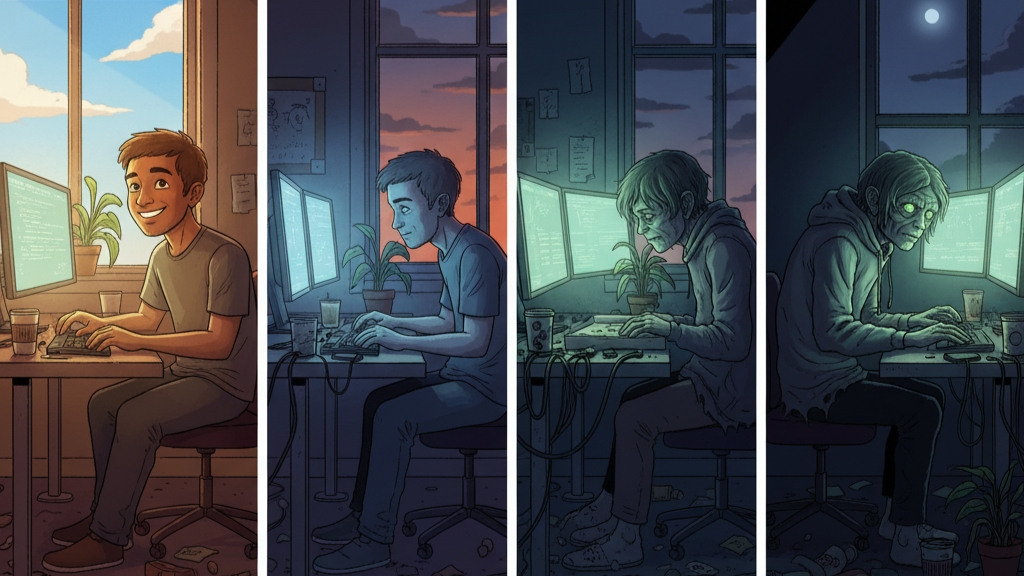
I looked down and realized I'd been wearing the same hoodie for four days straight. I couldn't remember the last time I'd seen actual sunlight. My houseplant (the one I named "Prod" because it never crashes) had started looking at me with concern. My neighbors probably thought I'd moved out.
That's when it hit me: I wasn't a remote developer anymore. I was a cryptid. A pale, keyboard-clicking creature of legend that occasionally ordered food delivery and scared the delivery person with my appearance.
The Statistics Are... Not Great
Let's get the uncomfortable numbers out of the way first:
- 66% of remote developers experience burnout symptoms (DigitalOcean report)
- 82% in the United States showing burnout symptoms (we're overachievers, apparently)
- 55% of remote workers exceed their contracted hours (shocking no one)
- 72 minutes saved daily on commutes... which we immediately donate back to Slack
- 2% higher burnout risk than office workers (we won the race nobody wanted to win!)
- 20% less burnout in teams with actual async practices (the promised land exists, we're just not there)
So basically, remote work was supposed to be the dream, and instead two-thirds of us are slowly transforming into burnt-out zombies who happen to know React.
Great. Just great.
The Cryptid Transformation Scale (Where Are You?)
I've developed a scientific scale to help you identify your current stage of cryptid transformation:
Level 1: Healthy Remote Worker (Rare, Possibly Mythical)
- Maintains regular schedule
- Takes actual lunch breaks away from desk
- Has seen sunlight in the last 24 hours
- Can remember what day of the week it is
- "Work-life balance" is not just a distant memory
If you're here: Congratulations! Teach us your ways, oh wise one.
Level 2: Boundary Challenges (Most Of Us Start Here)
- Sometimes checks Slack after 6 PM ("just quickly")
- Has worked in pajamas more than twice this week
- Lunch is eaten at desk while debugging
- The phrase "I'll just finish this one thing" has lost all meaning
If you're here: You're in the danger zone, but there's still hope.
Level 3: Work-Life Blur (Most Of Us Live Here)
- No clear distinction between work and home time
- Has responded to work messages at 10 PM without thinking twice
- Last vacation included "checking email just once" that turned into 3 hours of work
- The bedroom is now also the office and the line between them has vanished
If you're here: Welcome to the majority. It's not great, but you're not alone.
Level 4: Always-On Anxiety (The Danger Zone)
- Feels guilty taking any break
- Dreams about code (and not in a fun way)
- Can't remember the last time fully disconnected
- The thought "I could be working right now" poisons all rest time
- Physical symptoms of stress appearing
If you're here: It's intervention time. Seriously.
Level 5: Full Cryptid (Please Seek Help)
- Hasn't left apartment in 8+ days
- Sleep schedule more closely resembles a vampire bat than a human
- Communicates primarily through commit messages
- Houseplants have started staging interventions
- Delivery people have expressed concern
If you're here: This blog post is your wake-up call. We need to talk.
The Remote Work Promises vs. Reality
Let's talk about what they promised us vs. what we actually got:
The Promise: "Work From Anywhere!"
The Reality: Work from your bedroom, your living room, or if you're feeling fancy, the kitchen table. "Anywhere" somehow became "the same 4 walls for eternity."
The Promise: "Flexible Schedule!"
The Reality: "Flexible" means you can choose whether to work 9 AM - 6 PM or 9 AM - 9 PM. The flexibility is in how many extra hours you work, not when you stop.
The Promise: "No Commute = More Free Time!"
The Reality: Saved 72 minutes daily on commute, immediately reallocated to Slack messages, "quick calls," and "just one more bug fix."
The Promise: "Work-Life Balance!"
The Reality: Work-life blur. It's all one continuous stream now. What's balance? We don't know her.
The Promise: "Output Over Hours!"
The Reality: Output over hours, but also please be online at 9 AM for standup and also that thing at 6 PM and also did you see that message I sent at 10 PM last night?
Where The Hell Did My Boundaries Go?
The single biggest problem with remote work: there are no forced boundaries anymore.
In an office:
- You physically left at end of day
- Your commute was transition time
- Work laptop stayed at work
- Home was home
At home:
- Work is 6 feet away, always
- No transition between work and life
- Laptop follows you everywhere
- Home is also work
Your brain can't differentiate anymore. It's all just... one place. And that place is where you work and live and eat and sleep and gradually lose your mind.
The Async Communication Lie
Let's talk about the biggest lie in remote work culture: "We're async!"
What they say: "We value async communication. Respond when you can. No pressure."
What they mean: "We're async, except:
- Please respond to this Slack message in the next 5 minutes
- Check this document before the meeting (that's in 10 minutes)
- Did you see my email? I sent it 30 minutes ago
- Why aren't you online? It's 2 PM on a Wednesday!"
True async culture means response times measured in hours or days, not minutes. It means not expecting immediate replies. It means actually being okay with people being offline.
And you know what? Teams that actually practice real async see 20% less burnout. But most of us are stuck in "fake async" - all the downsides of remote work with none of the benefits of actual async culture.
The Cup Noodles Syndrome (When Your Home Becomes Your Prison)
Remember when working from home sounded cozy? Yeah, that lasted about 3 weeks.
Now it's more like:
- Wake up in bedroom
- Walk to desk (living room)
- Work for 4 hours
- Eat lunch at desk
- Work for 4 more hours
- Look around and realize you haven't left your apartment
- Feel weird guilt about taking a walk because "I could be working"
- Order dinner instead of going to get it
- Work some more
- Walk back to bedroom
Congratulations, your entire life now happens in a 500 square foot radius, and somehow you're still too busy to clean.
The Isolation Reality Check
Here's something nobody talks about: Remote work is lonely as hell.
Your daily human interactions:
- Stand-up call (camera off, obviously)
- That delivery person (who you scared with your appearance)
- Your houseplants (they're judging you)
- Your rubber duck (for debugging)
When pair programming starts feeling like a social event, you know something's wrong. When you're genuinely excited for meetings because it means talking to humans, that's a sign.
And the worst part? You can't even complain about it because everyone's like "but you're living the dream! Remote work!" Yeah, the dream where my closest confidant is ChatGPT.
The Burnout Symptoms Nobody Talks About
Everyone knows the obvious burnout signs (tired, stressed, etc). But here are the sneaky ones that crept up on me:
1. When Coding Stops Being Fun
It's just mechanical now. You're going through the motions. The joy is gone. You're a code-generating robot powered by coffee and spite.
2. The 2 AM Guilt
It's 2 AM. You're in bed. You can't sleep. Because you keep thinking about that bug. Or that feature. Or that PR review. "I could be working right now" loops in your head.
3. Decision Fatigue From Hell
What to eat? When to work? Should I respond to this message? Should I take a break? Every tiny decision feels enormous because you're making ALL the decisions ALL the time.
4. The Guilt Loop
- Taking a break? Guilt (I could be working)
- Working late? Guilt (I should have work-life balance)
- Not responding immediately? Guilt (they'll think I'm slacking)
- Responding immediately? Guilt (I'm setting bad expectations)
There's no winning. Just guilt.
5. Physical Symptoms You're Ignoring
- Back pain (from terrible posture)
- Eye strain (staring at screen 12 hours)
- Wrist pain (repetitive strain)
- Headaches (stress + screen time)
- That weird chest tightness (anxiety, probably)
"I'll deal with it later" you say, while your body stages a protest.
The Solutions That Actually Work (No BS)
Okay, enough doom. Let's talk about what actually helps. These aren't pretty, they're not easy, but they work:
1. Physical Boundaries (Non-Negotiable)
The rule: Work happens in ONE place. Not bedroom. Not couch. Not bed. One designated spot.
Why it works: Your brain needs spatial triggers. Desk = work mode. Couch = relax mode. When they're the same place, your brain never turns off.
How to actually do it:
- If you don't have a separate room, designate one corner
- Use a room divider, curtain, literally anything to create separation
- When work ends, physically turn away from that space
- Better yet: Leave the room entirely
2. The Shutdown Ritual (Game Changer)
The rule: Work day ends with a ritual. Every single day.
Examples that work:
- Close laptop, put it in a drawer/bag (out of sight)
- Walk around the block (even 5 minutes)
- Change clothes (yes, even if both outfits are pajamas)
- Write tomorrow's top 3 tasks and close notebook
- Literally say out loud "I'm done working now" (sounds dumb, works great)
Why it works: Your brain needs a signal that work is over. Without a commute, you have to artificially create that transition.
3. Device Boundaries (The Nuclear Option)
The rule: Work stuff stays on work devices. Period.
How to actually do it:
- Slack is NOT on your personal phone
- Work email is NOT on your personal phone
- If they have a problem with that, they can buy you a work phone
- Even better: Work laptop never enters bedroom
Why it works: Can't check work messages if you literally can't access them. Simple but effective.
4. Time Boundaries (The Hard One)
The rule: Hard stop time. Not aspirational. HARD STOP.
How to actually do it:
- Pick a time (say, 6 PM)
- Set an alarm
- When alarm goes off, you stop
- Yes, even if you're in the middle of something
- Yes, even if there's a bug
- Yes, even if your manager messaged you
Why it's hard: Everything feels urgent. Nothing actually is.
Why it works: If you don't protect your time, nobody else will.
5. The 90-Minute Sprint Method
The rule: 90 minutes coding, 20 minute break. Repeat.
Why 90 minutes: That's about how long your brain can intensely focus before performance degrades.
What "break" means:
- Stand up
- Leave your desk
- Look at something far away (rests eyes)
- Move your body
- Don't check Slack/email (not a break)
Why it works: You're human, not a machine. Act like it.
6. Social Solutions (Yes, You Need People)
Options:
- Virtual co-working (just being on a call while working)
- Local meetups (yes, in person)
- Co-working space (even once a week)
- Pair programming sessions (actual human interaction!)
Why it matters: You're a social species. Isolation makes everything worse.
7. The Communication Boundary Conversation
The hard truth: You need to have the boundaries talk with your team.
What to say:
- "I'm available 9-6, outside that I'm offline"
- "I check Slack every 2 hours, not continuously"
- "I don't respond to messages after 6 PM"
- "I take lunch from 12-1, I'll be unavailable"
What happens: Most managers are fine with it. The ones who aren't are showing you a red flag.
When Remote Work Might Not Be Right For You (And That's Okay)
Real talk: Remote work isn't for everyone. And that's fine.
Signs it might not be working:
- You've tried everything and you're still miserable
- The isolation is killing you
- You can't create boundaries no matter what
- Your mental health is suffering
- You miss the structure of an office
It's okay to:
- Ask for hybrid arrangement
- Look for office-based roles
- Admit remote work isn't your thing
There's no prize for suffering through something that doesn't work for you.
The Final Reality Check
Here's the truth about remote work in 2025:
The good:
- No commute (when you're not donating that time back to work)
- Flexibility (when it's real, not fake)
- Comfortable environment (when it's not also your prison)
The bad:
- Burnout rates are terrible
- Boundaries are non-existent
- Isolation is real
- Always-on culture is killing us
The solution:
- Set boundaries aggressively
- Protect them viciously
- Get help when you need it
- Remember: You're a human, not a code-generating machine
The Promise I'm Making to Myself (And You Should Too)
I promise to:
- Actually log off at my designated time
- Stop checking Slack after hours
- Take real breaks
- Leave my apartment at least once a day
- Remember that I'm more than my productivity
- Treat future me with the kindness I'd show a friend
Remote work can be great. But only if we stop letting it consume our entire existence.
You're not a cryptid. You're a human who deserves rest, boundaries, and a life outside of work.
Act like it.
P.S. - I wrote this blog post during work hours, took breaks, and logged off at 6 PM. See? It's possible.
P.P.S. - If you recognized yourself in the "Level 5: Full Cryptid" description, this is your sign to take tomorrow off and go outside. Seriously.
P.P.P.S. - My houseplant "Prod" says hi. He's doing better than me.
On this page
- The Moment I Realized Something Was Wrong
- The Statistics Are... Not Great
- The Cryptid Transformation Scale (Where Are You?)
- Level 1: Healthy Remote Worker (Rare, Possibly Mythical)
- Level 2: Boundary Challenges (Most Of Us Start Here)
- Level 3: Work-Life Blur (Most Of Us Live Here)
- Level 4: Always-On Anxiety (The Danger Zone)
- Level 5: Full Cryptid (Please Seek Help)
- The Remote Work Promises vs. Reality
- The Promise: "Work From Anywhere!"
- The Promise: "Flexible Schedule!"
- The Promise: "No Commute = More Free Time!"
- The Promise: "Work-Life Balance!"
- The Promise: "Output Over Hours!"
- Where The Hell Did My Boundaries Go?
- The Async Communication Lie
- The Cup Noodles Syndrome (When Your Home Becomes Your Prison)
- The Isolation Reality Check
- The Burnout Symptoms Nobody Talks About
- 1. When Coding Stops Being Fun
- 2. The 2 AM Guilt
- 3. Decision Fatigue From Hell
- 4. The Guilt Loop
- 5. Physical Symptoms You're Ignoring
- The Solutions That Actually Work (No BS)
- 1. Physical Boundaries (Non-Negotiable)
- 2. The Shutdown Ritual (Game Changer)
- 3. Device Boundaries (The Nuclear Option)
- 4. Time Boundaries (The Hard One)
- 5. The 90-Minute Sprint Method
- 6. Social Solutions (Yes, You Need People)
- 7. The Communication Boundary Conversation
- When Remote Work Might Not Be Right For You (And That's Okay)
- The Final Reality Check
- The Promise I'm Making to Myself (And You Should Too)